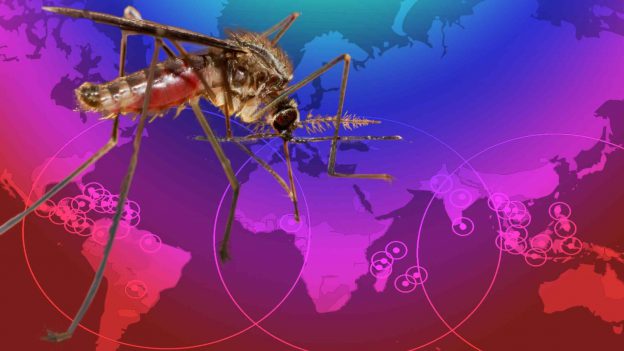
Zika is a mosquito-borne virus that in its urban cycle transmits between Aedes species mosquitoes and humans. Aedes can live in close contact with Humans. They preferentially feed on human blood. They can live in our house and leave to lay their eggs in standing water outside human residences. They are now understood to be other less common ways that Zika can be transmitted, vertically from mother to child during pregnancy, through sexual contact, and transfusion transmission.
So Zika historically is an African virus that was first isolated in Uganda in 1947. And then it caused sporadic and poorly-described human disease starting, the first human disease was recognized in west Africa in the 1960s. So from the ’60s until about 10 years ago, Zika caused small and focal outbreaks in Africa and Asia. But as you know starting in 2014, Zika was introduced into the Americas.
The virus has been introduced into 50+ new countries and territories in the Americas. So what happens when there is a Zika case that’s reported to CDPH, the Mosquito and Vector Control districts go out to the case’s residence, try to kill adult mosquitoes in the area and then remove the standing water containers to eliminate breeding sites.
Which mosquitoes are responsible for transmitting Zika? And this is epidemiologically-relevant because if you want to target vector control without a licensed vaccine, you have to know which species are transmitting the virus. After all, mosquitoes have different ecologies and different feeding behaviors and they also have different distributions.
One reason why it’s important to know whether North American Culex can transmit Zika is you’ll notice that their range extends much, especially for Culex pipiens much further north than the Aedes species. So when that press release came out, a lot of the Mosquito and Vector Control districts around the United States expressed a lot of concern in understanding whether there was a big host switch. So how do we know which mosquito species are competent vectors? As you know there are hundreds of different mosquito species around the world. And to the naked eye, they look very similar, but they are very different. And they’re not all capable of transmitting human and animal pathogens.
So there are four criteria that a mosquito species has to fulfill to be considered a competent vector. They have to be abundant, they have to survive long enough to transmit, they have to feed frequently on competent vertebrate hosts. So these are criteria that we can establish in field entomological surveys.
The fourth criterion is the one that researchers have been looking at which is that you can show in a laboratory setting that certain species are capable of transmitting the virus. This is a cross-section of a mosquito. Researchers ingest an infectious blood meal that goes into the mosquito stomach or the midgut. The virus has to infect the midgut epithelium and then disseminate onto the other side of the midgut into the open circulatory cavity of the mosquito and be in the liquid that bathes it, which is called the demolish. So that then it can infect the secondary target organs which in the case of a transition-competent mosquito would include the salivary glands. So that the virus will then be excreted into the saliva so that when the mosquito refeeds, she transmits it into a new host.
This period takes a certain amount of time in a mosquito. So the way we do this experimentally is we take viremic mice that have been inoculated with Zika, and then are at their peak of viremia. We anesthetize them and then we present them to cohorts of female mosquitoes of the different species that we’re interested in studying.
Then after the period that the virus moves through the mosquito body, we tear off the legs and the wings of the still-living mosquito and we inject the proboscis into a tube filled with liquid which stimulates salivation. So we’re essentially milking the mosquitoes. If we detect the Zika virus or RNA in the expectorant, we know that that species is transmission-competent.
There’s another interesting phenomenon that’s been observed which is that within a given mosquito species, there can be regional variations or geographic variations in the capacity for those mosquitoes to transmit.
So there’s also been an interest in understanding whether Aedes aegypti from one place is also as transmission-competent as Aedes aegypti from another place. This data synthesizes the field of vector transmission studies where you can see groups from various places have been collecting their local mosquitoes and then looking at the capacity of them to transmit.
Lab data confirms that Aedes aegypti from all over the world are capable of transmitting Zika as is Aedes albopictus from the one study in Germany. Looking at the Culex data, it is almost uniform that not a single mosquito was tested and unlike invertebrate studies, we have lots more mosquitoes, so our cohort sizes are often in 50 to 100. We can say out of the thousands of Culex that have been tested from around the world, they’re not transmission-competent, save for this one outlier study which I think could be potentially interesting.
So barring any methodological issues with the paper, this could be a case that there is something different about these Chinese Culex quinquefasciatus mosquitoes that enables them to transmit Zika. Alternately there could be something different about the Zika virus strain that was used in that Chinese study. It was an Asian lineage genotype virus, the same that’s circuiting in the Americas that was in a traveler returning to China. But overall, the burden of evidence shows that Zika has not shifted to use Culex mosquitoes as vectors.
Another question that scientists have been interested in, as you know there’s been a lot of curiosity as to what factors have promoted the emergence of Zika. On the mosquito side, one question is whether the spread of the Asian lineage virus has been promoted by enhanced transmissibility by the primary vector in most places, Aedes aegypti.
To address this question, Scientists took an ancestral virus in the Asian lineage from 1966 in Malaysia that was the low passage and compared that in the vector-competent experiment, side-by-side with the contemporary Puerto Rican strain.
They used an Uganda strain from 1947 and a Senegalese strain from 1997. Data shows 40% and 60% of the mosquitoes that fed on the mouse were capable of transmitting between seven and 14 days post-feed, but there was no significant strain-specific difference. This refutes the idea that the emerging Asian lineage Zika is more transmissible than its Asian lineage progenitor strain. So in fact the emerging viruses are doing worse in aegyptia than the African lineage strains.
So the reasons for having animal models of infectious diseases, We think are pretty obvious, but we feel that the placental and neurological development of nonhuman primates is closer to humans than that of mice. So even in the last year and a half, the Zika non-human primate field has rapidly advanced and globally know a lot already. Please find latest development from WHO on ZIKA virus here