Category Archives: Science Research

research related news

Inner Experience and Spiritual Unity

Introduction: Mystical Experience as a Human Phenomenon

Across history and cultures, human beings have reported moments of profound inner transformation—experiences marked by a sense of unity, transcendence, and deep insight into reality. These moments are often described as encounters with the divine, ultimate truth, or an all-encompassing presence. Rather than belonging to any single religion or philosophy, such experiences appear wherever humans turn inward in search of meaning.

Mystical experience occupies a unique space between religion, philosophy, and psychology. It does not rely on belief alone, nor does it depend entirely on ritual or doctrine. Instead, it emerges from direct inner awareness, often reshaping a person’s understanding of self, world, and purpose. In a modern world increasingly shaped by technology and external stimulation, this inward dimension continues to draw renewed attention.

What Is Meant by Mystical Experience?

Mystical experience can be understood as an immediate awareness of reality that feels deeper and more fundamental than ordinary perception. Individuals often report a powerful sense of presence, clarity, or unity that transcends everyday thought patterns. Unlike intellectual insight, this form of knowing is experiential—it is felt rather than reasoned.

Such experiences are frequently described as difficult or impossible to express in words. Language, shaped to describe objects and actions, struggles to convey states of consciousness where distinctions between subject and object dissolve. As a result, mystics across cultures resort to poetry, metaphor, paradox, or silence when attempting to communicate what they have encountered.

Recurring Characteristics Across Cultures

Despite vast cultural differences, reports of mystical experience share several recurring characteristics. One of the most notable is a sense of unity, where the boundary between the individual self and the wider reality appears to dissolve. This unity is often accompanied by intense peace, joy, or awe.

Another common feature is a perception of profound insight. Individuals frequently feel that they have encountered a deeper truth about existence—one that feels self-evident and authoritative, even if it cannot be logically explained. These experiences are usually brief, yet their impact can be long-lasting, influencing values, behavior, and worldview.

The Inner Journey and Transformation

Mystical experience is rarely portrayed as accidental or trivial. In many traditions, it is preceded by a period of inner struggle, self-examination, or detachment from habitual patterns. This process often involves confronting fear, doubt, or a sense of emptiness as old identities and assumptions loosen their grip.

Through this inner refinement, individuals become more receptive to transformative insight. When mystical awareness arises, it is frequently described as something received rather than achieved—a gift rather than a conquest. This sense of passivity reinforces the idea that such experiences emerge when the ego loosens its control.

Mysticism and Religious Traditions

While mystical experience often arises within religious contexts, it consistently stretches beyond formal structures. Religious traditions provide language, symbols, and practices that help individuals interpret and integrate inner experiences. However, mysticism itself often challenges rigid interpretations and encourages a more direct, personal relationship with the sacred.

Throughout history, mystics have sometimes stood at the edges of their traditions, respected for their insight yet viewed with suspicion for their independence. This tension highlights an important distinction: religion organizes communal belief, while mysticism emphasizes personal realization.

Eastern and Western Approaches to Inner Awareness

Different cultures have developed distinct approaches to cultivating mystical awareness. In many Eastern traditions, meditation and disciplined attention play a central role. Through sustained practice, individuals learn to observe thoughts, emotions, and sensations without attachment, gradually uncovering a deeper layer of awareness.

Western mystical paths have often emphasized devotion, surrender, and ethical purification. Here, transformation is framed as a movement toward alignment with a higher reality or divine will. Despite these stylistic differences, both approaches aim at transcending the narrow sense of self that obscures deeper perception.

The Role of Symbolism and Paradox

Because mystical experience defies straightforward description, symbolic language becomes essential. Light and darkness, fire and water, ascent and descent—these images recur across cultures as attempts to gesture toward what lies beyond conceptual thought. Paradox is especially common, as mystics attempt to convey truths that appear contradictory at the level of ordinary logic.

Rather than offering explanations, symbols function as invitations. They point the mind toward an experience that must be entered rather than understood intellectually. This symbolic approach distinguishes mystical discourse from philosophical argument or doctrinal instruction.

Mysticism and the Study of Consciousness

In recent decades, the study of consciousness has brought renewed interest to mystical experience. Psychologists and neuroscientists have begun examining how altered states of awareness affect perception, emotion, and cognition. Research suggests that mystical-type experiences can lead to measurable changes in well-being, empathy, and openness.

Institutions such as the Johns Hopkins Center for Psychedelic and Consciousness Research have explored how certain controlled conditions can occasion experiences with features similar to classical mysticism. While scientific frameworks differ from spiritual interpretations, both acknowledge the transformative potential of these states.

Mysticism Beyond Religion

In contemporary society, many individuals who do not identify with organized religion still report experiences that align with mystical descriptions. Moments of profound connection in nature, deep artistic immersion, or intense contemplative practice can evoke similar qualities of unity and insight.

This suggests that mystical experience may be rooted in universal aspects of human consciousness rather than specific belief systems. Spiritual traditions can nurture and interpret these experiences, but they do not monopolize them. This perspective helps explain the growing interest in secular mindfulness, contemplative practices, and spiritual-but-not-religious identities.

Ethical and Psychological Implications

Mystical experience is not merely about altered perception; it often carries ethical consequences. Individuals frequently report increased compassion, reduced fear of death, and a stronger sense of responsibility toward others. These shifts arise naturally from the felt experience of interconnectedness.

From a psychological standpoint, such changes can contribute to resilience and meaning-making. However, integration is crucial. Without grounding and reflection, intense inner experiences can lead to confusion or imbalance. Many traditions emphasize the importance of guidance, community, and ethical practice to support healthy integration.

Criticism and Skepticism

Mysticism has not escaped criticism. Skeptics argue that mystical experiences can be explained entirely through brain chemistry, cultural conditioning, or psychological projection. Others caution against elevating subjective experience above reason or shared ethical frameworks.

These critiques play an important role in maintaining balance. At the same time, the persistence and cross-cultural consistency of mystical reports suggest that they represent a genuine dimension of human experience worthy of careful study rather than dismissal.

Why Mystical Experience Matters Today

In an age marked by fragmentation, polarization, and rapid technological change, mystical experience offers a counterpoint rooted in unity and depth. By shifting attention from external identities to inner awareness, it encourages humility, empathy, and openness.

Rather than providing answers to every question, mysticism reframes how questions are held. It invites individuals to engage reality with curiosity rather than control, presence rather than certainty. This orientation has implications not only for spirituality, but for ethics, education, and mental health.

Conclusion: An Inner Dimension of Human Life

Mystical experience represents one of humanity’s most enduring and intriguing capacities: the ability to encounter reality directly at a level beyond ordinary thought. Across cultures and centuries, people have described remarkably similar inner transformations, suggesting a shared dimension of consciousness.

Whether interpreted through religious, philosophical, or psychological lenses, mysticism continues to illuminate the depths of human awareness. It reminds us that beneath doctrines, identities, and ideologies lies an inner terrain still waiting to be explored—one that has the power to transform how we understand ourselves and our place in the world.
Coma Berenices Star Constellations Astronomy Information

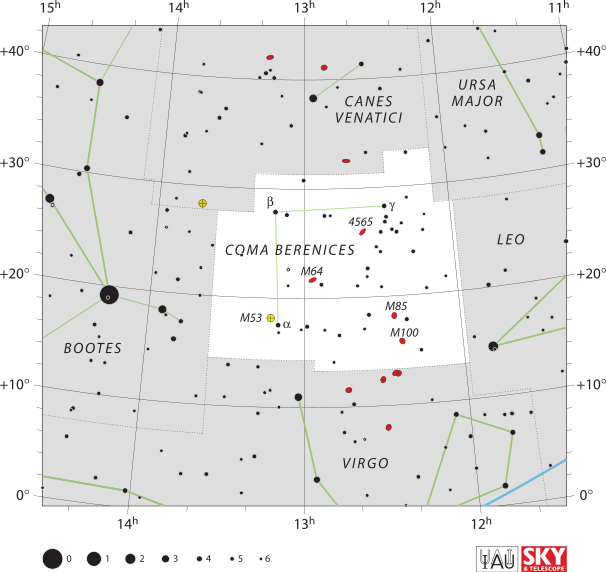
Coma Berenices means Berenice’s Hair in Latin, referring to the Queen Berenice II of Egypt. The main stars of the constellation are  Alpha, Beta, and Gamma Comae Berenices among which Beta is the brightest. Gamma Comae Berenices (15 Comae Berenices) lies 169 light-years from Earth and is an orange-hued giant star. The rich galaxy cluster, Coma Cluster, is located in this constellation. This is a whole another world and I advise you to read about this cluster here. Fun Fact: it was after observing Coma Cluster that Fritz Zwicky came up with the idea of dark matter – or that galaxies contain more mass than their visible, measurable mass. The giant, low surface brightness galaxy Malin 1 resides in this constellation. FK Comae Berenices is a variable star of the constellation and the Supernova SN 1940B which is the first type II supernova was observed in Coma Berenices.

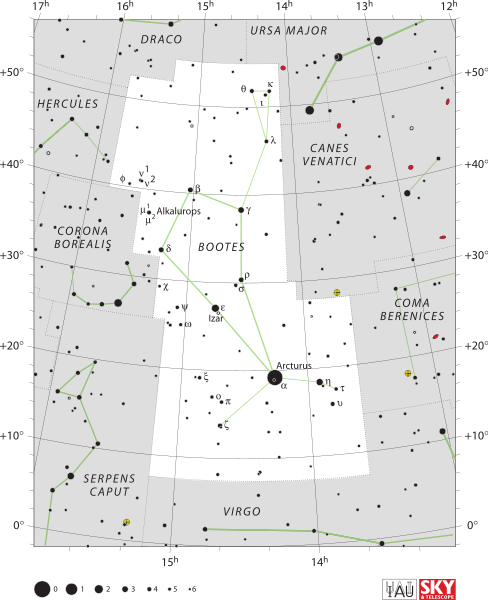
The image credits go to IAU.

For the multiple stars residing in the constellation, we have  21 Comae Berenices which is a close binary.  Coma Cluster is known to have eight spectroscopic binaries so far. The constellation itself has over thirty double stars, over 200 variable stars, and seven eclipsing binaries named CCDDEKRWRZSS, and UX Comae Berenices. HD 108874  and WASP-56 are the two stars hosting planets in this constellation. Coma Berenices also owns three globular clusters: M53 (NGC 5024), NGC 4147, and NGC 5053.

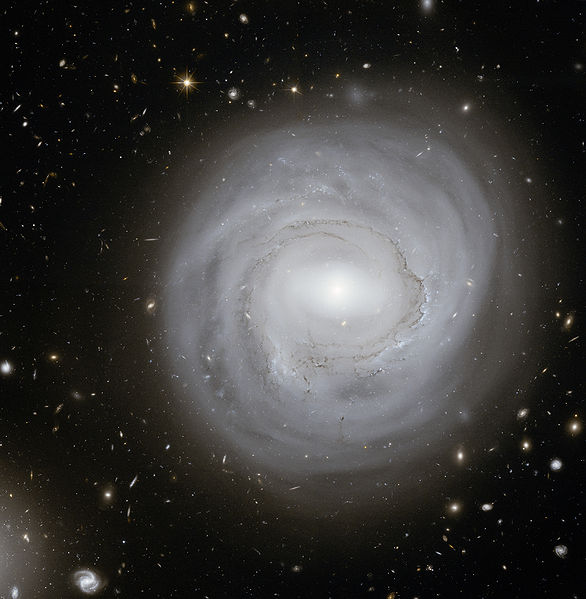
Due to being a part of Coma and Leo clusters and Virgo cluster, Coma Berenices contains a large number of galaxies. Some large elliptical galaxies such as NGC 4874 and NGC 4889 also reside in this constellation. The black hole at the center of NCG 4889 is one of the most massive black holes ever known (21 billion solar masses).  NGC 4921 is the brightest spiral galaxy of the constellation. Here we only name some of these galaxies which are more particular in features.

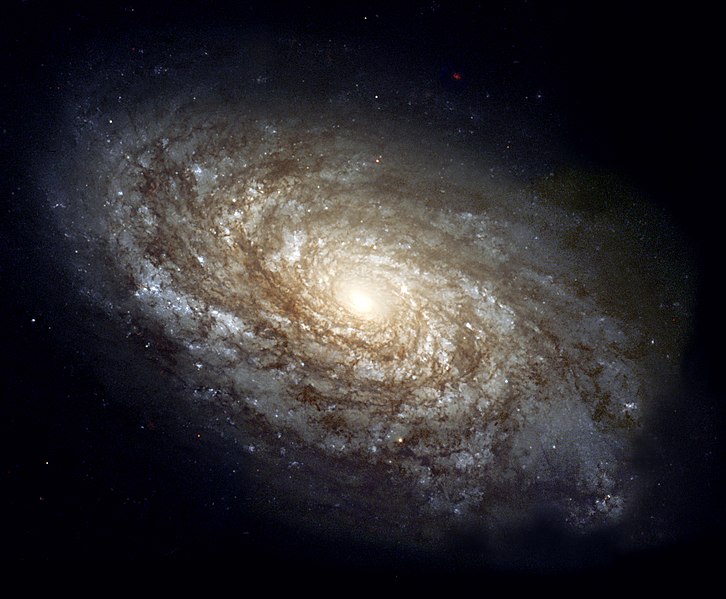
 NGC 4921 captured by HST.

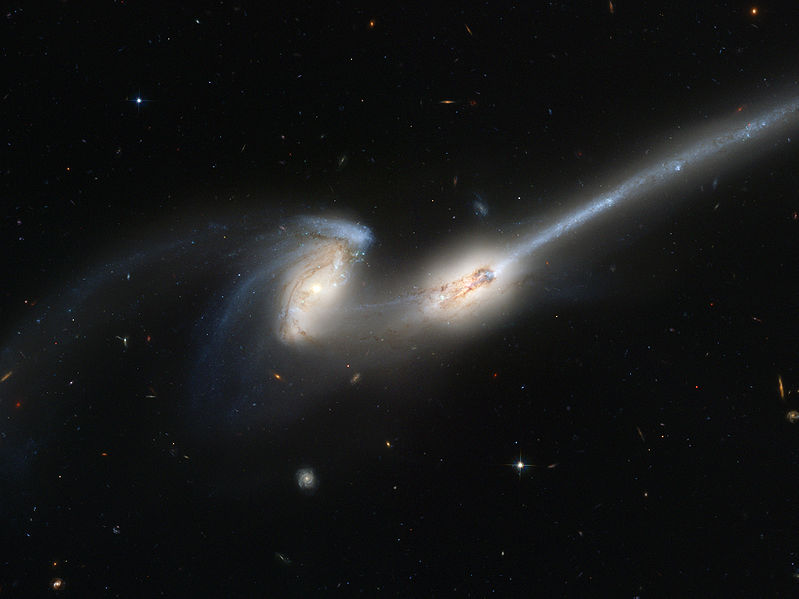
One of the interesting galaxies of this constellation is Mice galaxies located 300 million light-years from Earth which is composed of interacting galaxies. This encounter resulted in triggering star formation in both galaxies involved with long tails of dust, stars, and gas.

Mice galaxies captured by Hubble Space Telescope.

M85 (NGC 4382) is a lenticular/elliptical galaxy belonging to Virgo cluster, and it is interacting with the barred spiral galaxy NGC 4394.

NGC 4394 is a barred spiral galaxy (55 million light-years from Earth, located in the Virgo Cluster). The image credits go to ESA/NASA Hubble Space Telescope.

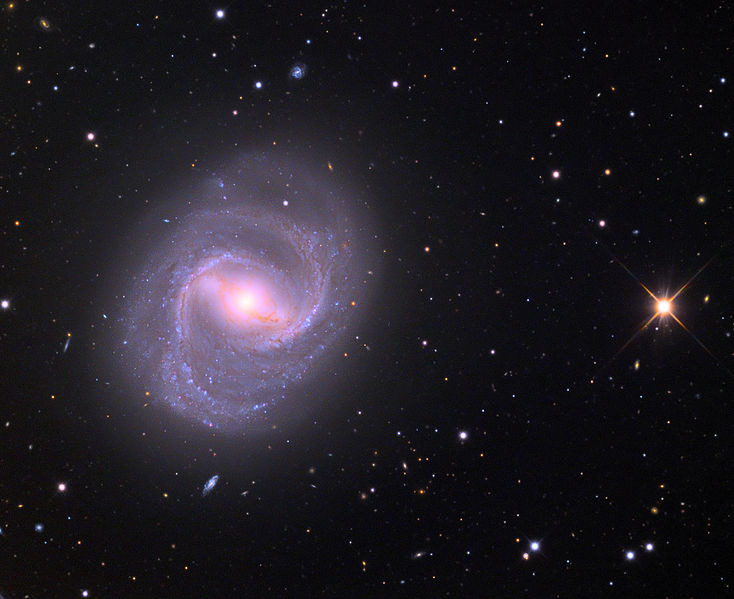
M88 is another spiral galaxy belonging to Virgo cluster. M91 is a barred spiral galaxy of this cluster, and M98 is an elongated spiral galaxy of this cluster. M99 and M100 are two other spiral galaxies residing in this cluster.

M88. The image credits go to ESA/NASA Hubble Space Telescope.
M91, a barred spiral galaxy captured by Hubble Space Telescope.
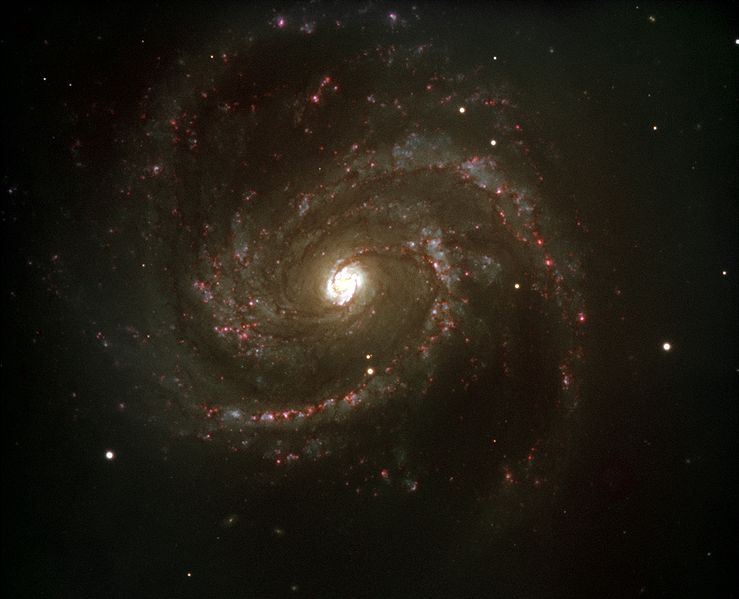
M99 captured at the Mount Lemmon SkyCenter.
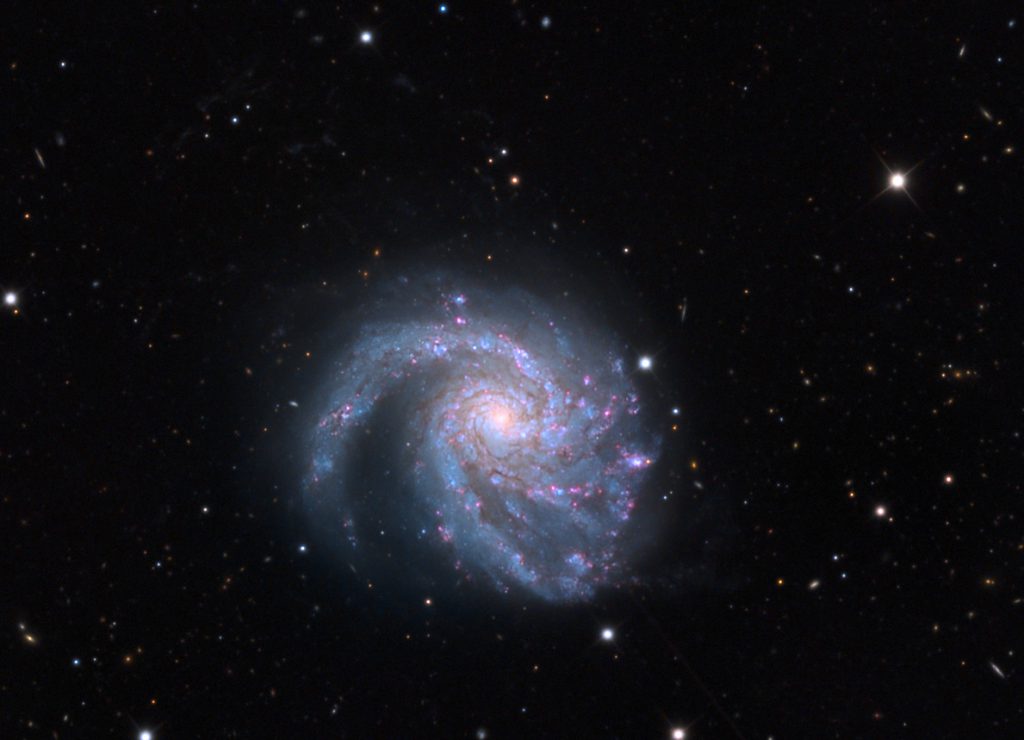
M100 captured by ESO/VLT.

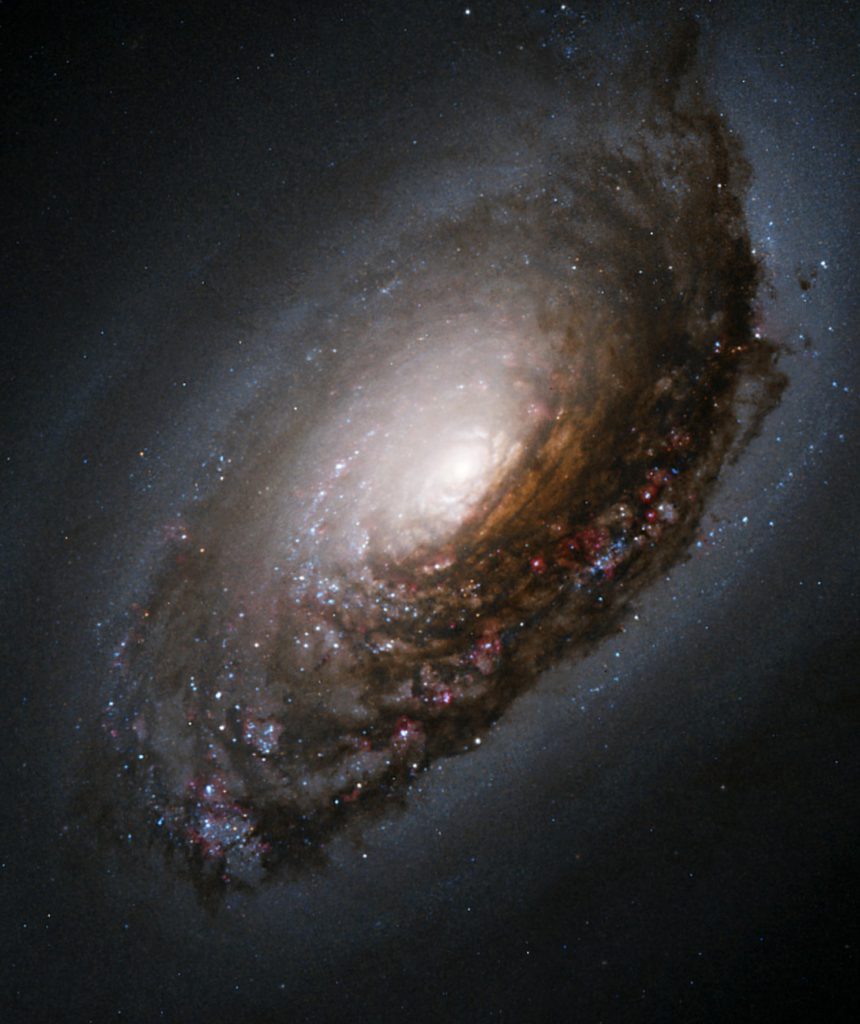
M64 is one of the most beautiful galaxies of Coma Berenices, which is also called the Black Eye Galaxy due to its long, dark dust lane covering most of it.

M64 or the black eye galaxy. Image credits go to NASA.

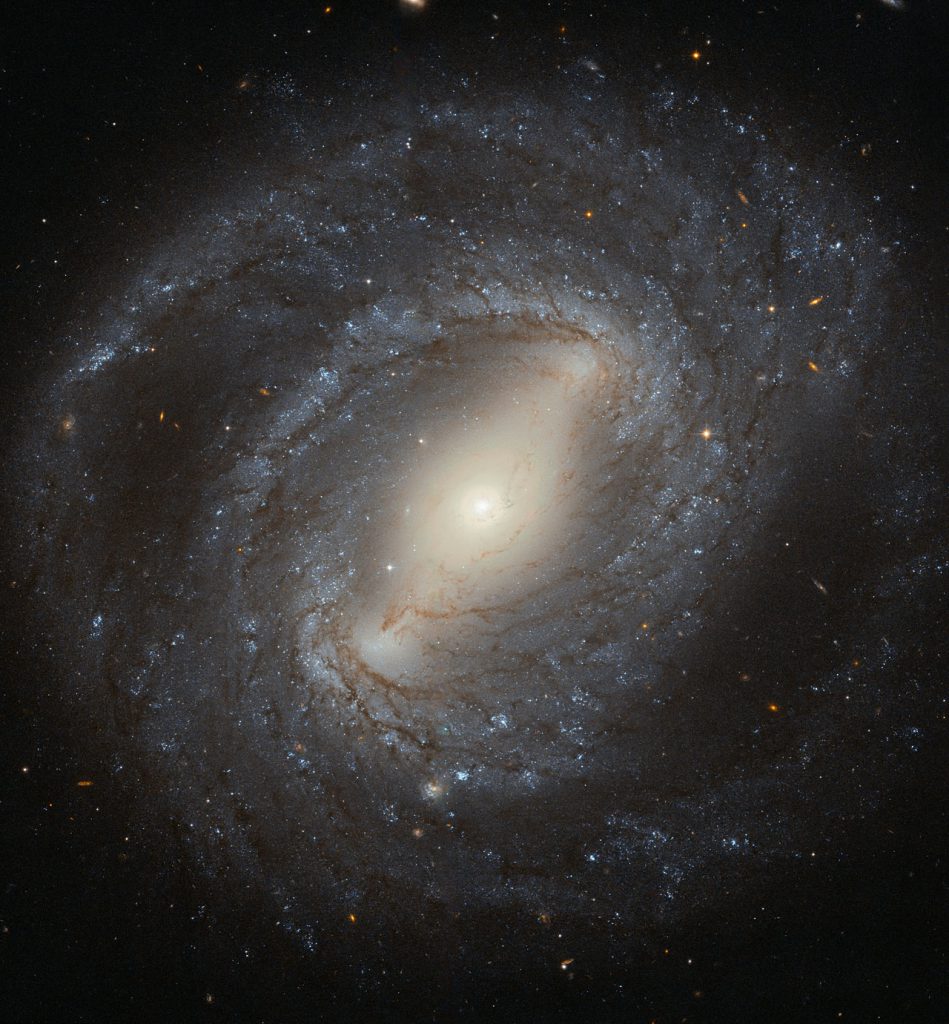
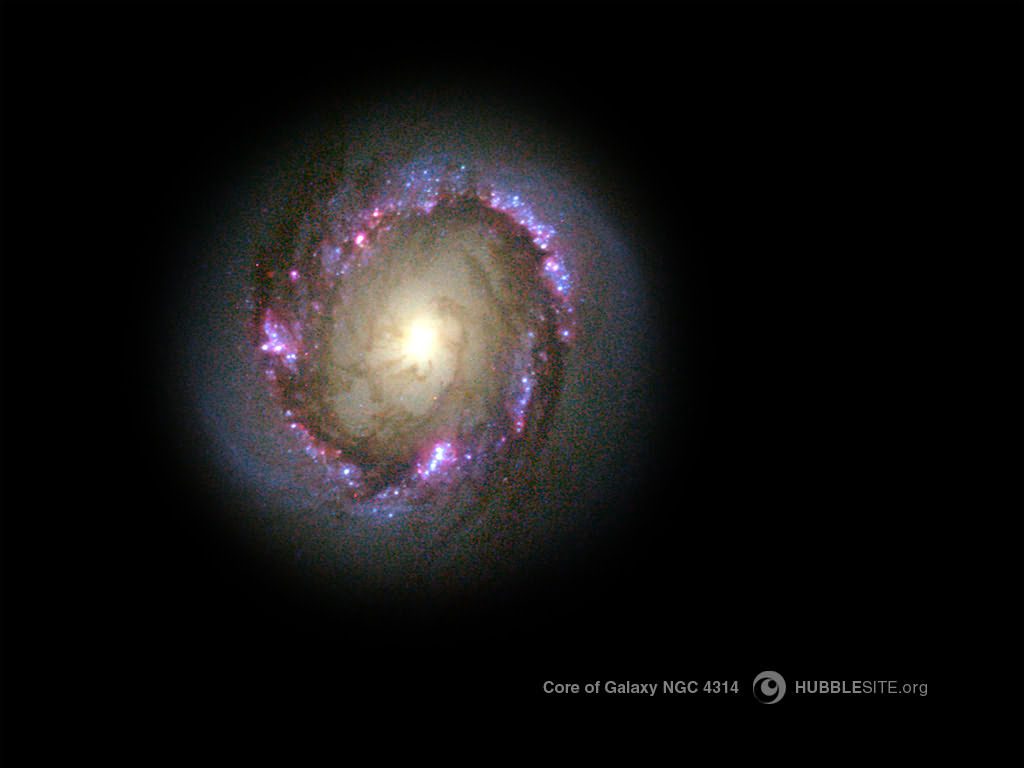
NGC 4314 is another beautiful galaxy (a barred spiral galaxy) located in Coma Berenices. NGC 4414 is, on the other hand, an unbarred spiral galaxy.

NGC 4314 captured by ESA/NASA HST.
NGC 4414, an unbarred spiral galaxy captured by ESA/NASA HST.

Musca Start Constellations Astronomy Information

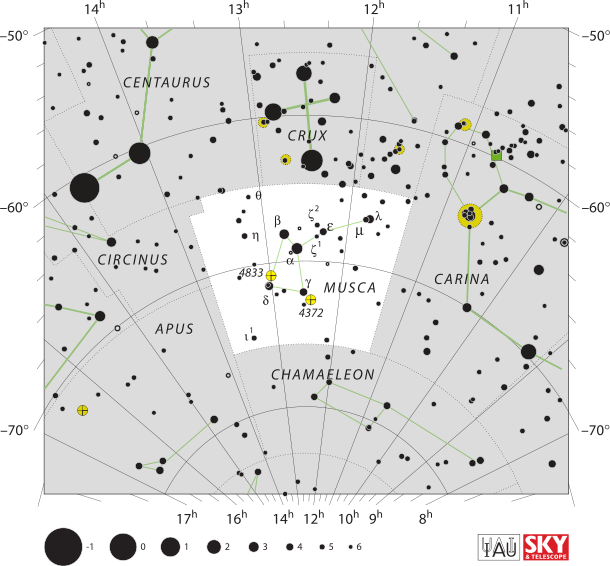
Musca (fly in Latin), is a small constellation. The stars, namely, are  AlphaGamma, Beta,  Zeta2, and (probably) Eta the Muscae, plus HD 100546. The last star contains a debris disk, and another object which can be either a big planet or a brown dwarf. Among its multiple stellar systems, Theta Muscae is a triple system, and TU Muscae and  GQ Muscae are two binary stars. R Muscae and S Muscae are two classical Cepheid variables. GR Muscae is an X-ray source composed of a neutron star and another star. The three stars that host exoplanets in this constellation are  HD 111232 (orbited by a planet of 6.8 Jupiter masses),  HD 112410 (has a planet of 9.2 Jupiter masses), and HD 100546 (a blue-white Herbig Ae/Be star).

Image credits go to IAU.

As for its deep-sky objects, there are the planetary nebulae NGC 5189,  IC 4191,  NGC 4071,  Coalsack Nebula, Dark Doodad Nebula, and Engraved Hourglass Nebula. There are also the globular clusters NGC 4833 and  NGC 4372.

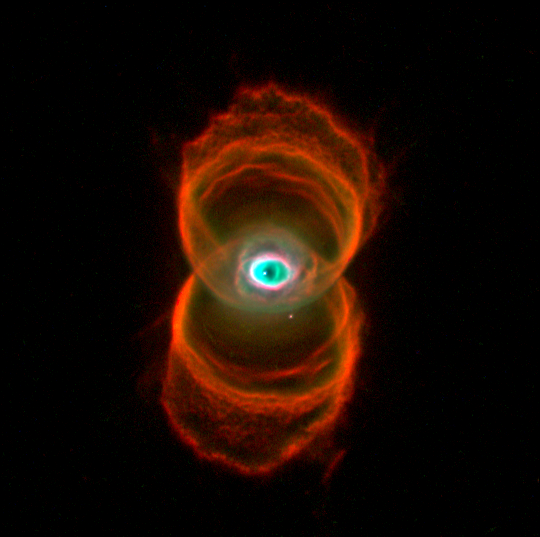
Engraved Hourglass Nebula captured by ESA/NASA HST.
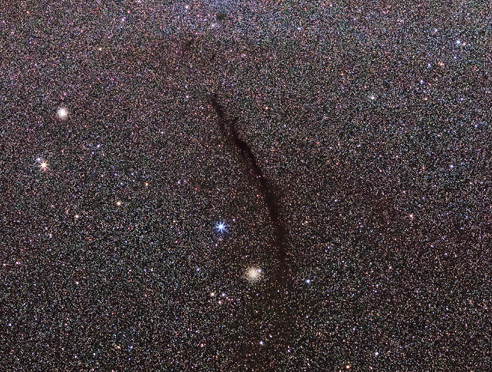
Dark Doodad Nebulae captured with a Canon EOS 5D Mark II and 135 mm f/2L lens at f/4 and ISO 3200 on an Astrotrac equatorial mount.

NGC 5189 captured by ESA/NASA HST.

Boötes star Constellations Astronomy Information

The first interesting thing about this constellation is its name which is dervied from Βοώτης, Boōtēs that means ox-driver, or herdsman. This name is attributed to the patron of farmers or the god Enlil (the leader of Babylonian pantheon). Its shape, however, was also likened to a kite or ice cream cone. Boötes was also listed among the 48 constellation listed by Ptolemy and still makes the list among the 88 modern constellations.  Arcturus, an orange giant, and the fourth brightest star in the night sky. Epsilon Bootis is a colorful multiple star which is popular among amatuer astronomers.  Eta Boötis is a spectroscopic binary, nine times brighter than our Sun. Beta Boötis is a yellow giant, and Gamma Boötis is a white giant.

Delta Boötis is a wide double star, the primary star is a yellow giant and the secondary componet is a yellow main sequence star. Mu Boötis (Alkalurops) is a famous triple star (same as the other triple star Epsilon Boötis) located 121 light-years away from Earth. Epsilon Boötis is also called Izar (loincloth in Arabic) or Pulcherrima (most beautiful in Latin). Among other multiple stars located in this constellation, Xi Boötis is a quadruple star, Pi Boötis is a triple star, and Zeta Boötis is a triple star. Zeta Boötis contains a physical binary plus an optical companion to this binary system. 44 Boötis (i Boötis) is a yellow star to naked eye, and is a double variable star very close to Earth (42 light-years away). The orbital period of this double star is 220 years. ZZ Boötis is an eclipsing binary star system. T Boötis is a particular case, as it is a nova, and a nova is classified as a transient astronomical event. A nova is the sudden brightness of a star that fades away and there are a number of reasons behind this event. T Boötis was observed in the April of 1860, and was never observed again.

Boötes is not only home to many multiple stellar systems, but also stars hosting multiple planets or single planets. Wasp-14 is a F5V-type star hosting a curious exoplanet. WASP-14 b is one of the densest exoplnets discovered so far (7.341 MJ and 1.281 RJ) via transient method. Tau Boötis is a star in Boötes constellation which is orbited by a giant planet (with a period of 3.31 days and 5.95 Jupiter masses, thus this planet is a hot Jupiter) and has a companion GJ527B. HD 128311 hosts two planets, and  HD 132406 is a G0V star (like our Sun) hosting a gas giant discovered in 2007. WASP-23 also hosts one planet, and HD 131496 is a K0 star orbited by one planet. HD 132563 is a triple sytem with one component being a planet (this planet was discovered in 2011 by radial velocity method). Triple systems like HD 132563 which consist of one planet and two stars are rather rare (or not many of them has been confirmed yet) and are a hot topic in astronomy these days.

29 stars in total are visible to naked eye in night sky in Boötes constellation. Boötes is surrounded by Coma, Virgo, Canes Venatici, Hercules, and Ursa Major.

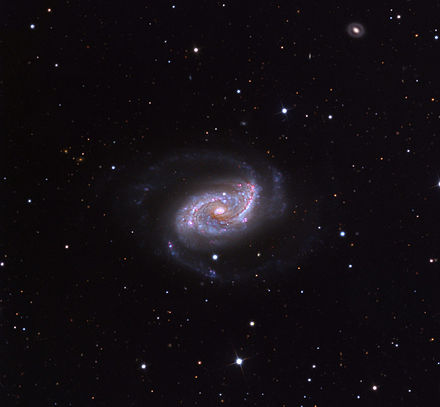
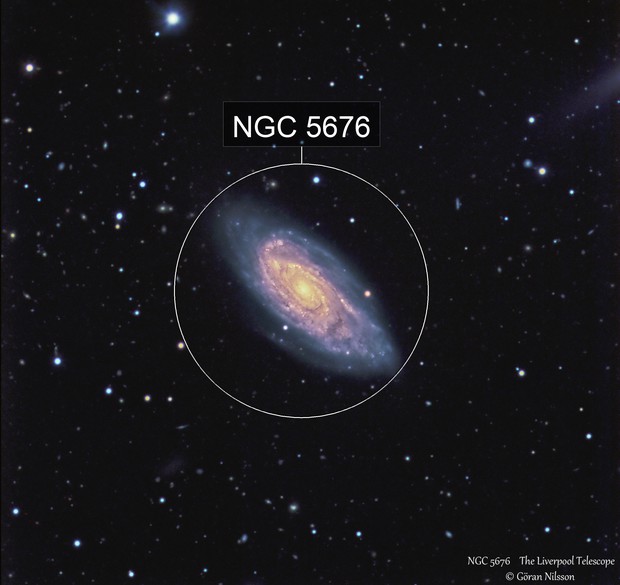
The deep sky objects of Boötes are plenty, among which are globular cluster NGC 5466. As of galaxies, NGC 5248 (Caldwell 45) is a spiral galaxy lying 50 million light-years away from Earth and is a member of Virgo galaxy cluster. NGC 5676 is another spiral galaxy located in Boötes.

NGC 5248 (Caldwell 45). The image credits go to wikimedia.

The image credits go to Liverpool Telescope.

NGC 5548 is a particular galaxy in this constellation, as it is a Seyfert galaxy. A Seyfert galaxy is a type of galaxy which has an active nucleus at the center (quasar-like center) with a high surface brightness. There is a supermassive black hole (or another dark, very massive object) at the center of this galaxy which amke its center appear so bright.

NGC 5548, which has a supermassive black hole at its center – the image credits go to ESA/NASA Hubble telescope. A clumpy gas stream is flowing outwards, blocking 90% of the X-ray emission of the supermassive black hole at the center. Benchamrks such as this system provide insights into how supermassive black holes interact with their host galaxies.

Boötes void is another particular feature of this constellation. 250-million-light-year in diameter, this huge space is devoid of any galaxies and it is 700 million light-years from Earth.  

Hydra Star Constellations Astronomy Information

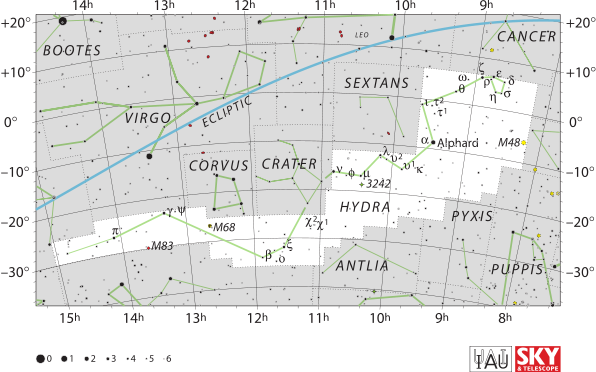
Hydra (the sea serpent) constellation is the largest among all the 88 modern constellations, 1303 square degrees wide and 100 degrees long. Although large, it does not contain any particularly bright star of the night sky.  Alphard (an orange giant), is a moderately bright star, followed by  Gamma Hydrae (a yellow giant), and  Beta Hydrae (a blue-white star). Epsilon Hydrae is a bright binary star, and  27 Hydrae is a triple star. Among its variable stars, we can name  R Hydrae, U Hydrae (a semi-regular variable star), and  V Hydrae (home to two exoplanets). GJ 357 contains three exoplanets, including one super-earth (GJ 357 d) lying in the star’s habitable zone.

The image credits go to IAU.

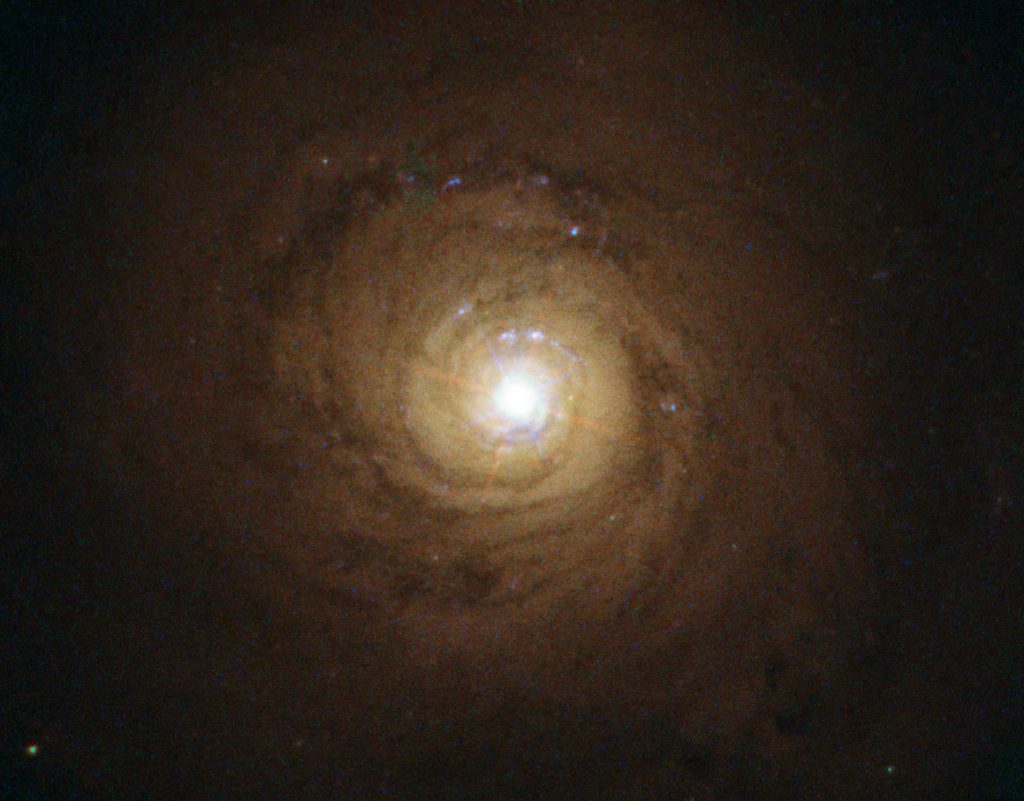
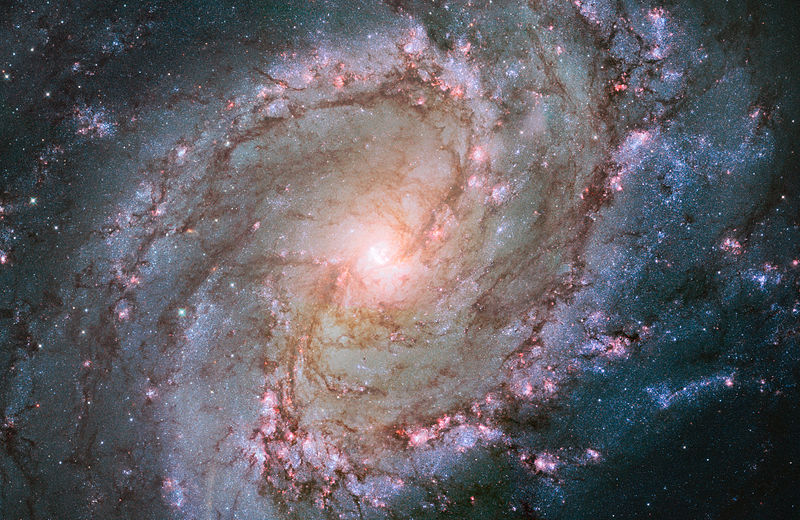
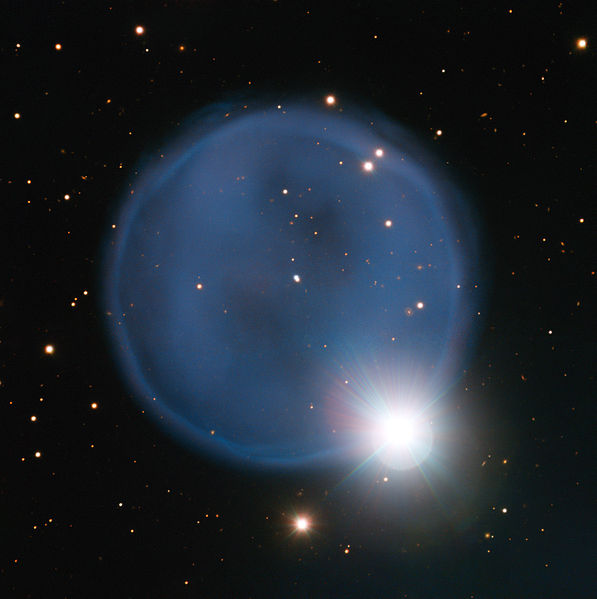
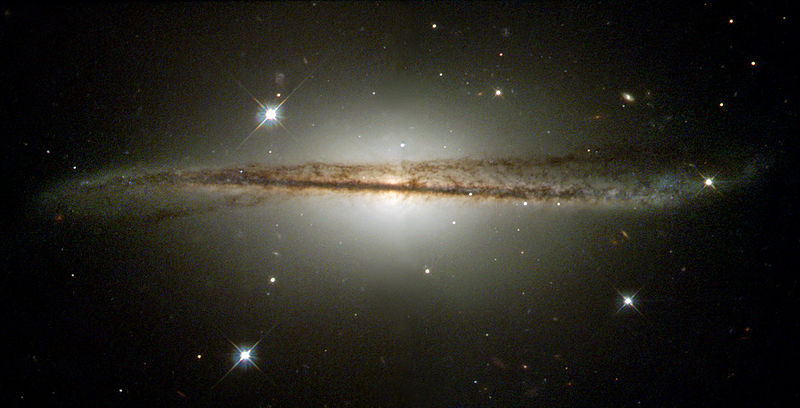
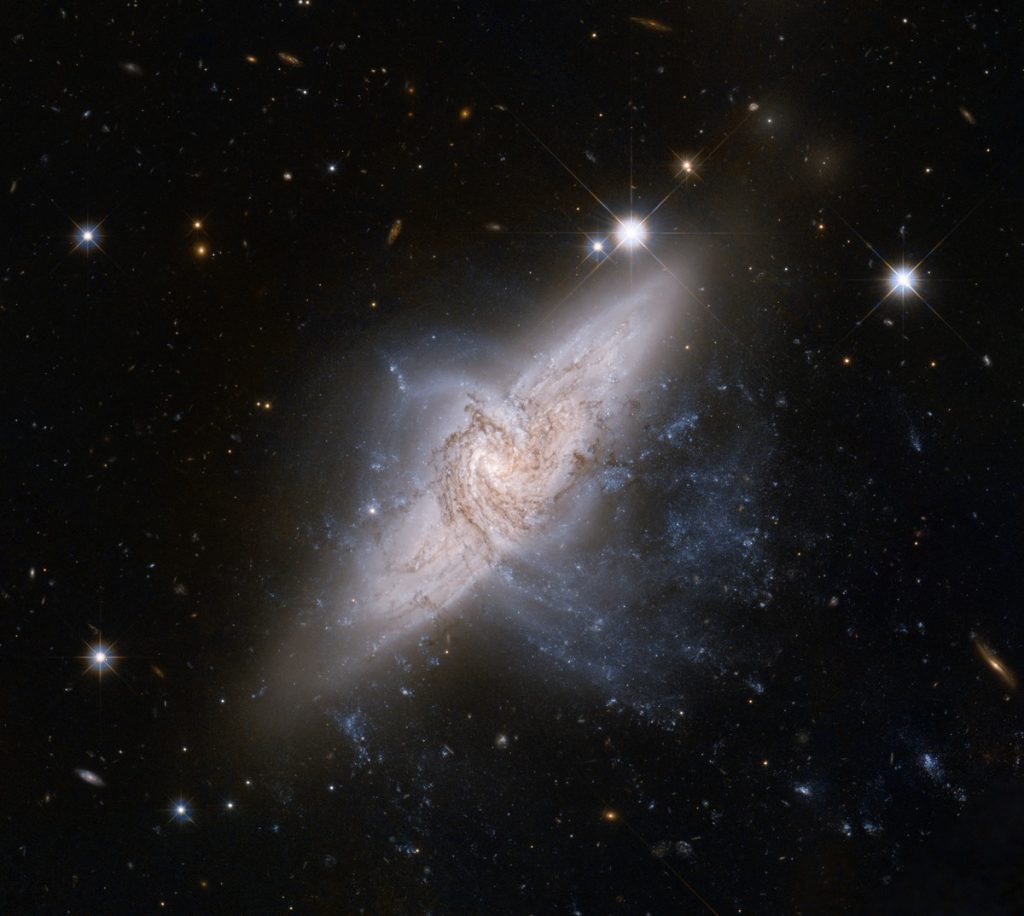
The Hydra constellation contains some deep-sky objects, among which is the spiral galaxy M83 (Southern Pinwheel galaxy).  M68 is a globular cluster in the vicinity of this galaxy. Other globular clusters of the cluster are:  M68 (NGC 4590) and  NGC 5694. Planetary nebulae NGC 3242 and Abell 33 also belong to this constellation. Its open cluster is M48 (NGC 2548). NGC 3314 is a particular case as it is composed of two galaxies that are not interacting but seem that way. ESO 510-G13 is a beautiful warped spiral galaxy, located 150 million light-years from Earth. There is also an important elliptical galaxy residing in this constellation named NGC 4993 in which two neutron stars merged and gave rise to several electromagnetic sources such as  GW170817GRB 170817A, and SSS17a.

M83 captured by ESA/NASA HST.
Abell 33 captured by ESO’s VLT.
Warped galaxy captured by ESA/NASA HST.

NGC 3314 captured by ESA/NASA HST.